 Hidden Notes & Clues
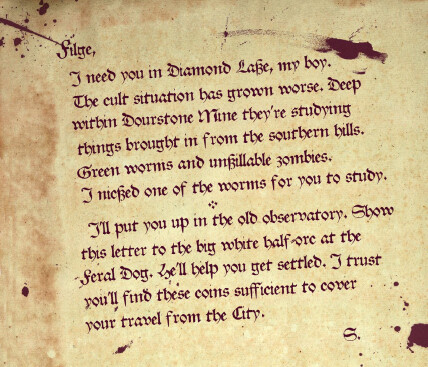
- letter found at the old observatory
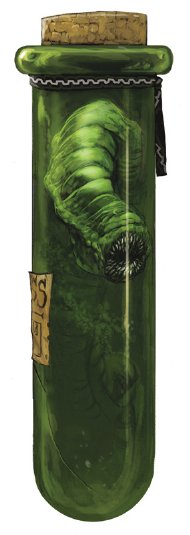
- dead green worm in vial found at the old observatory
- from Filge when he was still alive
Why Are You Here? “Me mate Balabar called me up from Sharn for a bit of study about some weirdness in town. He got himself brought down to a hidden part of the Dourstone Mines a month ago, to set up some provisioning deal with the dwarf what runs the place. But the mine was crawling with awful beasts in hooded robes. He said their wild cries made his stomach heave. The cultists — they called themselves the Ebon Triad — said something about the Age of Worms, about strange undead in the southern hills and the swamp. Smenk knew he had to prepare a defense, so he called in his undead expert. Me.”
- from Filge when he was still alive
The Ebon Triad? “Smenk says the cult follows the Mockery, the Keeper, and the Shadow. If true, the place must be crawling with delicious secrets."
- from Filge when he was still alive
The Green Worm? “Balabar nicked that jar from a laboratory in the Dourstone Mine. It’s very rare. The cultists mentioned those were involved in the creation of ‘unkillable’ zombies."
- from Allustan
The Green Worm? “It’s indeed very rare. Dead now, of course, but once it and hundreds of worms like it must have wriggled within the abscesses and orifices of a powerful undead creature called a spawn of Kyuss. These are probably the ‘unkillable’ zombies the cultists mentioned to Filge. If true, it could be a real problem. Those worms can get inside you and turn you undead in about a day.
- from Allustan
The Murals in the Wispering Cairn? Hezcalipa was a couatl (winged serpent) sage from the Age of Demons, who along with the blue dragon Ourelonastrix helped discover the Draconic Prophecy. The vultures represent the Wind Dukes of Aaqa, powerful noble air elemental myrmidons from Syrania the Azure Sky, who were pledged to the couatls and aided them (as well as the dragons) in their battle against the Demon Overlords. The black eyes represent a Sphere of Annihilation, a powerful but also dangerous artefact, those Wind Dukes of Aaqa seemed to have wielded as a weapon. My conclusions suggest, that these Cairns were dedicated to their sacrifice.
- from Allustan
The Draconic Prophecy? The Draconic Prophecy is a record of things to come that has been playing out since creation. The prophecy encompasses many many volumes and is said to be as complex and unfathomable as the dragons themselves. A few among the scholarly study snippets of the massive work, but only creatures with incredibly long lifespan or immortals have the ability and patience to see the prophecy for what it truly is.
- from the book Cults: Within and Without, Garken Loeb. Provost of the University of Wynarn 789 YK.
Known alternatively as the Three Faces of Darkness, the Three Faces of Evil, or the Ebon Triad depending on region. This mystery cult believes in the union of the Shadow, the Keeper, and the Mockery. Lacking any of the altruism found in typical Three Faces cults that try to reclaim and recontextualize a single member of the Dark Six by placing them alongside a pair of Sovereigns, this cult revels in its evil nature. Practicing humanoid sacrifice, and general mayhem.
The core tenant of this cult is the belief that the Ebon Triad is destined to unite into one entity, an Overgod. United into one entity the Overgod’s power will be an order of magnitude greater than the sum of its parts. With this power the Overgod will cast down the Sovereigns, bring forth an age of darkness, reward its followers, punish its followers’ enemies. The typical promises found in most cults who entirely embrace evil unironically.
The exact nature of this unification varies, but the most popular interpretation is that the bones of the Keeper will be overlaid with the flayed skin of Mockery, and once infused with the very essence of the Shadow will become a new all powerful being.
Fortunately these cults, by the nature of the personalities involved, tend to be incredibly unstable. Forming often as alliances of convenience between followers of the three separate dark gods looking for some common ground. Once they have no more use for each other the pretense is dropped and they turn on one another. However the damage they can cause in the meantime is too much to let such a cult fester. Once involved in the cult, followers tend to be driven to further and further extremes to one up each other to prove they are the most evil.
The exact origins of this cult are not known. The earliest references to the Ebon Triad can be found in reports of isolated island communities in the Lhazaar Principalities that had turned to cannibalism and debauchery.
- Excerpts from Theldricka’s Journal, Mockery monk of an Ebon Triad Cult
Praise Be to the Sovereign of Unjust War,
The Faceless One grows increasingly concerned. That addled beast Grallak Kur has yet to provide new insights into the Overgod’s nature.
The crude missives he sends speak of the worms, of a slumbering power that must be awoken, but nothing more. I wish he would go back to the black pit that spawned him if he has nothing more to offer. The Faceless One tells me this ties into an ancient figure, a being of great power. Of course, he tells me little else. He enjoys keeping his secrets, but he forgets that they flourish only behind the protection of the Mockery. His latest taunt is a scroll that he tells me contains all the answers I seek. Of course, the fool wrote it in a cipher. Were it not for the dictates of the Ebon Triad, I would lead my troops into their damnable labyrinth and kill every last bird and wizard within it.
Grallak is the key. Thank the Scourge that he trusts me and not the Faceless One. Otherwise, I doubt the Faceless One would bother imparting anything to us. We cannot trust this warlock. When the Overgod arises, I think it will be time to settle some old scores.
[…]
With Betrayal and Bloodshed We Conquer,
Grallak Kur has finally yielded a useful clue. I personally delivered it to the labyrinth, and the Faceless one giggled like a blood addled berserker when he saw the message. Grallak spoke of the worms again, of course. He says that even now they stir and writhe. The world is like an apple infested with them. All seems well for now, but soon they burst through the skin and swarm across the land.
Still, part of this vision troubles me. Grallak spoke of a great power behind them, but the Ebon Triad teaches that these worms will awaken the Overgod. Is there some other power at hand here that we cannot see? Is it friend or foe?
The Faceless One knows more, but he of course has little to say. Perhaps Grallak has invented everything. His monstrous kin are few in number and battered after their pilgrimage through Khyber. If he is an imposter or trickster, we may need to root him out of this place. In that case, our agents must make another supply run. Six coils of rope, and perhaps bows and more arrows, should do the trick. With the petitioners leading the way we can uncover any ambushes they have within the cliffs.
- Prophecy uttered by Grallak-Kur, Keeper oracle of an Ebon Triad cult
THE WORMS THE WORMS. EVEN NOW THEY WRITHE BELOW THE CHAPEL. THE WORLD IS LIKE AN WORM INFESTED APPLE. SOON THEY WILL BURST THROUGH THE SKIN AND SWARM ACROSS THE LAND. THE GREAT POWER STIRS AND A SWARM OF WORMS IS AT HAND. A POWER GROWS IN THE DARK CATHEDRAL’S POOL. A POWER THAT WILL SERVE THE THREE SIXES AS TOOL. A CHAMPION THAT WILL AID US BY FORCE OR WORD. A STILL GREATER FORCE DRIVES THE POWER OF EVIL FORWARD. AT LAST THE WILL OF THE TRIAD OF SIXES BE DONE. WITH THE RETURN OF KYUSS THE AGE OF WORMS IS FINALLY COME!
- written note from The Faceless One, Shadow warlock of an Ebon Triad cult
The secrets of this page are most holy. Know ye heretics who invade them that the Shadow is upon you. If you read this, Theldricka, you have either slain me and doomed our cause, or the time is nigh for our final victory.
At last the riddle of this place is solved. In ages past, a great being known as Kyuss rose above the petty warlords who fought and struggled for material gain. Mighty Kyuss is the herald of the Overgod. Soon, he will sound the clarion call to the faithful. The three sundered faiths shall be made whole.
The undead our agents spotted in the Mistmarsh must be located and captured. If they bear the worms of Kyuss then they perhaps hold the final answer to our research. The Ebon Aspect stirs within the pool, but it is still not ready to emerge. Perhaps a traumatic event – an invasion by heretics, a great battle fought within these halls – could awaken it. But even then it will attain only a minor form.
The Way of the Ebon Triad speaks of the danger of awakening the Aspect too soon. Our work will be for naught.
We must find the worms and the undead hosts that carry them. If they are not here, then we must send agents to the Rift. If Kyuss himself, or his agents, cannot shepherd in the Age of Worms, then we shall do it ourselves so that the Overgod may live.
Our course is clear, my dear Theldricka. Smenk is longer useful to us and must die. Kill him, then send agents to the Mistmarsh, across the western hills. I believe that we will find what we are looking for there, among the lizardfolk. Summon more of your warriors. If the calculations and portents are correct, the time for covert action is at an end. As the Age of Worms begins, we must strike hard and fast to prepare the coming of the Overgod.
Of course, dear Theldricka, if you were so rash as to slay my followers and I, then you, soon, shall join me in the afterlife. Doubtless your treachery has already stirred the Overgod. Our mission has failed, and you will die at his hands.
- Excerpts from “Humanoid Husbandry and Care” by Chyrassk the mindflayer
The most important aspect of raising humanoid livestock is to provide the herd with conditions that, on the one hand, guarantee their survival, but, on the other hand, do not extend too far beyond the minimum needed for that survival. It should be borne in mind that people are creatures bestowed with great intelligence, or rather cunning and instincts that allow them to gain as much as possible from their environment.
In terms of husbandry, this means humanoids will always try to obtain more than we give them. It is recommended, therefore, to provide each individual with a place to sleep, a meal twice a day and permanent access to water. These conditions, which might seem overly luxurious to some, ensure the optimal production of high quality cranium (more details on diet in later chapters). Also essential is access to air, without which humanoids die within minutes.
There is no need to be concerned about the ability for humanoid livestock to multiply in the conditions described above. If they are ensured a minimal existence and male and females of the same race are mixed, they will copulate irrespective of whether they are in captivity or not.
It is worth mentioning here that there is a school of thought that suggests treating humanoid livestock with greater freedom and care, including providing them with better quality fodder and a certain degree of freedom. This allegedly ensures a greater amount of favorable elements in the cranium and makes it tastier, however, it is worth mentioning that this method of husbandry is much more difficult and requires emotional bonding techniques, which will be discussed in the following chapters.
- The Apostolic Scrolls
Fabulously rare scrolls rumored to have been penned by Kyuss himself which each detail the creation of Ulgurstasa, and which empower an Ulgurstasa to create even more powerful undead, spewing them out at a tremendous rate. This minor artifact consists of a 5-foot-long sheet of vellum sewn to a pair of darkwood rollers. Several copies of the scrolls are thought to exist, and all have the same purpose—providing the user with the ability to contact one of the “Apostles of Kyuss” so it can perform a mass sacrifice in honor of its master. The scrolls are written in Abyssal and contain a long and complex litany filled with horrific imagery and descriptions. The magic of an Apostolic Scroll can only be used once, the sinister knowledge written there however remains.
- note written by the archmage Balakarde 16Y ago; recently found by the archmage Tenser
Port Verge is the Key. Missing heretics never captured … Possible site of Ebon Triad foundation? Did they turn to the Cult of the Keeper for aid and then more recently to that of the Shadow? Are new Triad leaders trained somewhere in Port Verge and then sent out to start their own cult cells in other cities?
To Do:
- Lashonna (helped defeat heretics; may know more about them that wasn’t printed)
- Rhorsk (research indicates that he did not flee Port Verge after it fell – he is probably dead but may have left some sort of legacy)
- Ebon Triad (are they still active in the city? Find out if their original hideout/shrine still exists)
- last entries from the 16Y old journals of the dead archmage Balakarde; given to you by Lashonna
It is as I suspected. The ancient undead dragon Mazyralyx is the herald of Katashka the Gatekeeper. It was granted its unlife by the demon Overlord thousands of years ago. Katashka gave Mazyralyx the gift of unlife and in doing so bound it eternally to the Overlord’s will. …
The Rite the Gatekeepers somehow obscurred Mazyralyx’s phylactery from thought, history and sight … as if it never existed at all. But the Circle of Storms of the Gatekeepers were no fools. They suspected that one day Kyuss will rise again, that his worms would learn to walk once more … …
Mazyralyx’s presence in the world has been quiet for the last several ages. The loss of its phylactery 3000 years ago left it a coward. Yet my research proves it stirs from its long sleep. That it now intends to waken Katashka the Gatekeeper after all this time. Why now? What has changed? I fear that the journey to the “Lair of the Keeper” to confront the dracolich is my only remaining option.
- Laila’s research about “Valaara” in a hidden section of the great library of Korranberg, Zilargo
VALAARA
Known as the Crawling Queen and the Keeper of Worms among other titles, Valaara is one of the fleshswarping daelkyr and master of insects. Its form, though decisively alien, is often depicted as a female humanoid with parts of its body appearing more like chitin than flesh. Insects flutter and crawl around on its body, acting both as a wriggling, buzzing type of clothing and as an extension of its insectoid appearance.
Valaara has absolute control over worms and insects, using them as spies and soldiers alike, and their likeness is found in the creatures who find themselves subjected to this daelkyr. Some humanoids who follow Valaara can undergo extreme physical alterations as their bodies change through metamorphosis to become more insect-like. This change is not exclusive to just the exterior as the follower’s mind also begins to change, taking any sense of individuality from the creature and replacing it with an uncanny need to conform and serve the hive of Valaara. Not all who follow Valaara undergo these physical transformations, as some instead take on a behavioral likeness to insects or start breeding maggots and worms.
The alien mind of the daelkyr makes their motivations incomprehensible to mortals. However, this doesn’t stop followers from congregating around the creatures, following a decree that may or may not align with the ideals and bonds of the daelkyr. Some followers of Valaara can even lose themselves to the hive mind that is its congregation. Traces of the person they were starts to fade as their ideals and bonds are replaced to fit the needs of the hive.
- Laila’s “Katashka” research - Kings of Khyber, a book about terrors in the Underdark
Katashka thrives on mortal fears of death and the undead. He is thought to have brought the first undead into the world, and certainly created the first liches and dracoliches. Katashka’s prakhutu (= herald) is the dracolich Mazyralyx, thought by some to be the origin of many myths of the Keeper. The location of Katashka’s prison is a mystery. The Lair of the Keeper in the Demon Wastes is a possibility, but it’s just as possible that this contains a connection to his heart demiplane. Katashka’s cults are more widespread than many other overlords, which suggests that his prison has been shattered and scattered?
As Katashka is known to create liches, one possibility is that pieces of his shattered prison are used as phylacteries by his lich champions, who spread his influence wherever they go. Katashka largely works with undead as opposed to fiends; his champions include the ancient sorcerer Kyuss and his spawn.
- Laila’s “Katashka” research - Legends of the Demon Wastes, definitely not a travel guide
Lord of death and undeath, Katashka is the master of the most ancient undead creatures. In addition to rakshasas, he is served by vampires, revenants, and a number of dracoliches – corrupted champions of the first great war. His chief agent is the runescribed dracolich Mazyralyx, said to be the first dragon to fall to this fate and possibly the inspiration for some myths of the god known as the Keeper, one of the Dark Six.
- Laila’s “Katashka” research - Libris Mortiis, a book about undead
The most terrifying powers in Eberron are the Overlords of the Age of Demons: the first children of Khyber … and even while imprisoned, they can touch the world through dreams and the actions of their servants.
The overlord Katashka possesses power over death. In the ancient battle against the dragons, Katashka raised a host of horrors, and those that survived the war are now the oldest undead creatures in existence. Katashka was imprisoned at the end of that conflict, but a number of his rakshasa servants still remain at large.
- Laila’s “Katashka” research - Death Cults in Eberron, a historical perspective to death in various religions
According to legend, 3,000 years ago Katashka merged his soul with a mortal sorcerer named Kyuss, and the combined entity briefly became a force that could shatter gods. Before Kyuss could gain his full power, however, the entity was imprisoned once more. Legends say, that if he is released again, he will bring forth the final age of the world, known as the Age of Worms.
Katashka can guide the thoughts of those who worship him and help them to draw dark magic from the heart of Khyber itself. Death cults have appeared throughout history – the Dhakaani records speak of a sect of necromancers wiped out by a powerful emperor, and several stories of human death cults predate the rise of Galifar.
The overlord Katashka embodies the fears of both death and the undead. People often assume that the followers of the Blood of Vol want to become undead, but it is Katashka’s cultists who embrace this dark destiny. His loyalists dream of a world where the dead reign over the living, reveling in the power death holds over the rabble, secure in the belief that Katashka will either grant them immortality through undeath or raise them when they fall.
- Laila’s “Katashka” research - Van Richten’s Guide to Demon Lords, memoirs of a Silver Flame inquisitor
Katashka thrives both on the fear of death and fear of the undead. As such, his cults might spread plagues or otherwise cause mass death, or they might unleash ghouls in the sewers or trigger zombie outbreaks. His intent is not death itself – the Grim King draws strength from the fear of the living. As such, Katashka rarely seeks to kill people swiftly. The primary purpose of the lingering plague is to sow fear among those fighting it, and the small pack of ghouls that causes long-term terror is more effective than an army that wipes out a city in a day. Likewise, Katashka’s undead champions revel in their unnatural condition; they want people to know what they are and to fear them.
The Gatekeeper’s cults are often transactional, with cultists serving the Grim King in exchange for secrets of necromancy or undead servants. Corrupted cults will in some way tie to death or the undead; Katashka also produces revenants. Katashka’s cults have no established territories, but are actually rarer in Karrnath than elsewhere in the Five Nations, as the Blood of Vol presents a different path to necromantic magic along with a more positive overall message for followers.
There are some obvious similarities between Katashka and the Keeper, and some scholars assert that they are one and the same – that Katashka’s actions in the Age of Demons inspired the myths of the Keeper. A critical difference is Katashka’s focus on undeath. In contrast, priests of the Keeper also deal with general greed, offering deals that have nothing to do with death or undeath.
Though he is truly bound by the power of the Silver Flame and only dimly conscious of the world, legends say that he can still observe standing ruins from the Age of Demons, his chosen servants among the fiends, and any location where his name or title is spoken for a short time.
- “Thank You” letter written by the ancient silver dragon “Martha”
Thank you for saving Eberron. As thanks, we wanted to give you something from our hoards. Also I want to thank you personally for putting Lashonna, the undead abomination that once had been my mother, to rest. – The Chamber