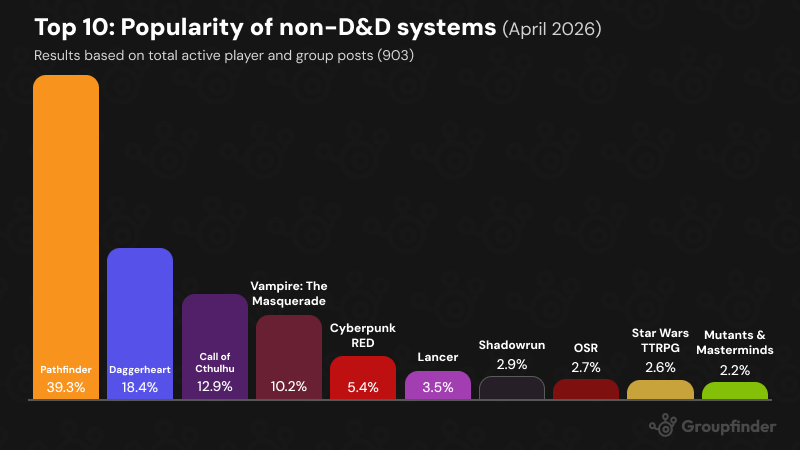
I was recently informed that Daggerheart is all the rage at the moment. Being completely out of the loop, I wanted to ask all of you fine folk your opinions. I know it’s a bit unfair to compare it to 5e but that’s inevitably what will happen. What does it do well? What can it improve on?
I’m not such a fan of 5e combat, does Daggerheart do things differently?
a success/success-at-cost/fail/fail-with cost dice system
similar to PbtA games but with 2d12
a pool of points for PCs/DM … similar to 2d20 Modiphius games
although they are used to fuel “spells/powers” instead [ = in a less narrative way than ]
ancestries/species and classes/subclasses that scream “Hey we are not so different than D&D 5E” - please try me"
also used some nice features like cards where your features are described (like Quest of Yore for those who game with kids^^), and individual character sheets filled with info so you do not get easily overwhelmed
It is made for a certain type of gamestyle (like the CriticalRole streamers play) … so if you like that and the stuff above, you will be happy
… if not you likely won’t be
p.s. book comes also with some advice how to build campaigns
… nothing groundbreaking or new … but still nice
it is less about tactics (still some stuff there), and relies more on the PbtA style 2d12 rolls and points PC / the DM gains from those rolls to “fuel” attacks/spells/powers
so it cares more about dramatic failures and epic rolls so everyone can cheer or cry out in vain
(if I would be mean, I would say: “good for streaming”)
From my limited but very fun experience playing/running Daggerheart, it emphasises collaborative storytelling more than 5e. It expects the GM to invite players into building out the world and adventures as things progress (for example, via prompt questions), and explicitly adds mechanisms to support that (the Hope/Fear duality dice add degrees of outcome that make the GM lean more into improvising or not overly preparing because things are less binary). It also makes rolling a more conscious act for important, narrative relevant moments, so you won’t be rolling for Perception in a well-lit room to understand what is there.
On combat, the aspect I enjoy the most of the design is that there is no separation of the out-of-combat and in-combat mechanics. It’s all the same fundamental flow of play between GM and players, with just some additional restrictions on the action economy. Less crunch, so each ability fits into a small card and has all the information required there. Initiative-less system, where players act when they feel, and the GM has rules on when they can/should interrupt players. I think it flows better, it’s less bogged down by “let me review my prepared spells or do I still have a bonus action?” and because it places again more focus on narrative, encourages players to think about what the character would do in the moment. Tag team rolls are also very fun.
It’s a game that has borrowed mechanics from many different systems that predate it, like PBtA, 13th Age, D&D, etc., but I think it’s quite streamlined in the way it combines them. For GMing it’s a system I prefer because prep is easier. Adapting things from other systems really comes down to asking questions about narrative role and picking and choosing some simple mechanics to reflect that which are usually already available in some form or another in the core content. As a player, it’s another system to play, as I also happily play crunchier systems.
Improvements, I’d definitely say more content, especially for less experienced people or those with less time to homebrew things, but that comes with time and community effort.
For sure! I just think the rules and the book do well to encourage discarding the “roll for things that are easy” mentality. I’ve (briefly) been at tables where DC 5 was asked for trivial tasks, but if you do that in Daggerheart, you’ll max out everyone’s Hope and Fear quickly so the system expects there to be some restraint there. Mechanically, there’s not really a built-in disincentive like that in 5e.
I personally like system more where the resources (Hope/Fear in Daggerheart) you generate during play, can be spend to add directly to the narrative … and not to fuel class-features/spells
e.g.
as a player you can spend 2 “Hope” to state, that you find a hidden door
and the DM can spend 2 “Fear” to state, that the door is trapped
in Daggerheart this sadly does not fly
but as I have been told
You can maybe spend 2 Hope to get advantage on finding the hidden door, but it’s not just letting you do things by will, it’s just to help you do things easier. For the cost of a resource you get if you roll well, which in real life (speaking from experience) isn’t always the case.
Honestly I still consider myself a newbie to it after playing it for 3 months now, but I think you can get a lot of information from either @cat4laugh or @DannyTheFrog as they have been GMing a lot and spend many hours with the system. ^^
I think that’s exactly the comparison the game is angling for, isn’t it?
In any case, I’m not particularly impressed and don’t see much in the way of new ideas – but others have way more experience with the game than me and seem to have found something worthwhile.
There’s been a bit of discussion about this over on ye olde discord if you want to wade through … nah, never mind. Better to just ask here.
I will not argue the points that have made before a lot of @dc.almeida 's takes I agree with. It’s borrowed from pretty much everywhere and is an algamation of a lot of stuff that works surprisingly well. If you want to compare it to DND then you could call it a slimmer more story focused version. If you compared it to pbta you would call it a more strategic and restrictive. version.
I find that this mix works very well for me and often brings back the joy of when I first started DND back to me without all the annoying and needless complexity. I also feel like I have to do less work for my collaborative world building GM style. Wheras in DND it was all kinda stiff it has been very smooth sailing for me.
In addition to all that I also enjoy that adversaries are simpler to run, high level games do not get bogged down and combat in general is more cinematic and less sloggish than DND is, physical cards are fun and help new players, characters are created in minutes not the 5e half hour.
Whoa, let’s not be hasty here with the conversion process. You’ve got dissociated mechanics galore; one of those weird gameable metacurrency economies; a yes-but / no-and resolution system, which tends to be fun for a while and then gets stale fast; and the DM’s position is made untenable by the decision of when to employ fear.
No, seriously, don’t let me dissuade you. Give it a shot. But I think it’s definitely a try before you buy game.
I have been running it for over half a year to a year now. But yes I highly encourage everyone to try it. The rules are free online with the srd so there really is no entry cost. I’m also not religiously tying to recruit I am just having a lot of fun with it and am trying to understand why people struggle with it so much.
But you should also give Spenser Starke some credit, Alice is Missing, Kids on Brooms. The man knows what he is doing
Edit: in general I feel like you need to give a ttrpg system a try for one to three games to really get a feel for it

 ]
]

 )
)